Out of the books we have
come across this year, The Mosquito Colony by Uduak Nkang happens to stand out.
First it has the best message about malaria, and how it’s crippling our
continent, Africa. The author did amazing job by portraying different types of
mosquitoes, their effect on human, and their cure, in a way that’s very
entertaining and will definitely keep the reader glued to this book.
Below is what the book
is really about.
The Mosquito Colony is
a blend of fantasy and facts. It blasts into the inner circle of governance and
let bear it intrigues, glamour and challenges. It pursues fundamentally the
ideology that government is the father of a nation, and must lead in a nation’s
quest for greatness. It also x-ray factors militating against the advancement
of contemporary African society, from Cairo to Cape Town, from Dakar to Darfur;
the soaring scourge of malaria, the glaring realities of imperialism, the
weakness of the citizenry and the gains that lies beyond of gate mediocrity,
nepotism and greed. This book is intended to spurall Africans, particularly the young
generation towards self-mastery. In a rather subtle but profound manner, The
Mosquito Colony pushes for a more united nations of Africa. It is a compendium
literary expressions, and perhaps, the first African prose of its kind.
The Kenyan author was jailed without trial for a year in 1978 and as his
prison memoir is reissued, he discusses the need to resist injustice
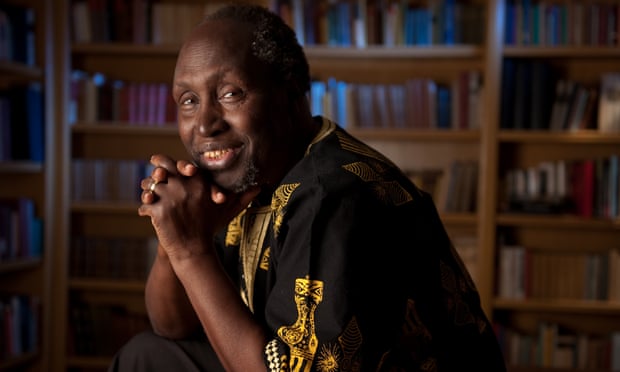
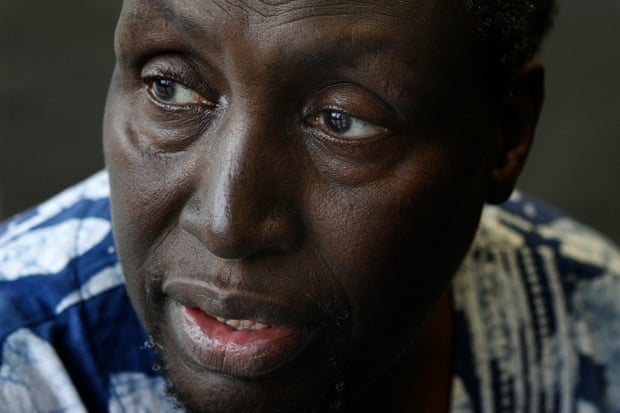
Ngũgĩ wa Thiong’o believes in the imagination. Perhaps that seems
obvious for the decorated Kenyan novelist, scholar and playwright, who’s
been publishing for over 50 years. But imagination, and all art, for
him, is not just a form of creativity; it’s a form of resistance. In his
case, once imprisoned for his political beliefs, it was his most
important possession in a brutal environment meant to break him.
His memoir, Wrestling with the Devil looks back at his year-long
imprisonment in 1978, when, after being arrested in the middle of the
night, he was held without trial, in a maximum-security prison. The
memoir is a trimmer version of the original work, Detained: A Writer’s
Prison Diary, published in 1982. Asked why he chose to publish this
updated version now, he replied, “The theme of resistance, and writing
in prison, is eternal.”
Despite decades of exile, I still feel the pull of my homeland
He committed many acts of resistance while he was jailed, but the
memoir deals with the most significant one: the writing of his novel
Devil on the Cross on thick, scratchy, prison-issued toilet paper. The
legend of the book has become as much a part of its story as the plot
itself, about a young woman dealing with racial and gender oppression in
neocolonial Kenya.
Because Ngũgĩ was never charged, tried or sentenced, he had no way of
knowing how long he would be held. The novel was “a form of spiritual
survival”, he says.
“It’s hard to say how I would have reacted after 10 years. But I was
scheming as to how I’d survive. I was thinking I’d write the novel in
Gikuyu. I didn’t know how long that would take. If it took a year, I
thought I’d take another year translating it into Kiswahili or English. I
was planning ahead, even then.”
The state’s goal in jailing him, he surmises, was to make an example
of an outspoken intellectual. He was arrested for his role in the
writing and staging of a play, Ngaahika Ndeenda (“I Will Marry When I
Want”), produced by and starring local peasants, who had no previous
theatre experience, and limited economic means. For Ngũgĩ, who was
openly opposed to the government, it was clear what his jailing meant.
In the memoir, he writes, “If the state can break such progressive
nationalists, if they can make them come out of prison crying, ‘I am
sorry for all my sins,’ such an unprincipled about-face would confirm
the wisdom of the ruling clique in its division of the populace into the
passive innocent millions and the disgruntled subversive few.”
“They would come and ask me why I was detained. It was very
annoying,” he says with a laugh. “They were seeking some kind of
confession. They wanted me to confess my sins, and I had no sins to
confess, in a political sense.”
He was advised early on in his stay by another prisoner, “Don’t let
them break you.” Understanding how dire the situation was – he and
others weren’t allowed books, radios, pen, paper; food was often
bug-infested; they were kept in their cells 23 hours a day – it’s clear
the particular importance for him of maintaining his psychic integrity
and beliefs.
For him, those beliefs were rooted in Kenyan independence from the
British, the right of the people to live on their own terms, instead of
what had come to pass in the late 19th century: British settlers taking
over the land and resources, hauling native Kenyans into detention
camps, forcing Kenyans to give up their culture and replace it with
theirs.
Over time, Ngũgĩ worked to decolonize his own mind – renouncing his
baptismal James, and Christianity; ceasing to write in English. It’s
that last decision that many people still question.
“If I meet an English person, and he says, ‘I write in English,’ I
don’t ask him ‘Why are you writing in English?’ If I meet a French
writer, I don’t ask him, ‘Why don’t you write in Vietnamese?’ But I am
asked over and over again, ‘Why do you write in Gikuyu?’ For Africans,
the view is there is something wrong about writing in an African
language.”
For years, he’s advocated for African writers to write in their
mother tongues, including in his seminal work Decolonising the Mind: the
Politics of Language in African Literature, because he understands how
integral language is to culture and identity.
“Remember that the first thing that happened to African people [in the Americas] was forced
loss of language and names,” he says, speaking of the transatlantic
slave trade. He says he’s gained great inspiration over the years from
African Americans, in culture and politics. “The resistance of African
American people is one of the greatest stories of resistance in history.
Because against all those arduous conditions they were able to create …
a new linguistic system out of which emerges spirituals, jazz, hip-hop,
and many other things.”
It’s hard to hear the word “resistance” and not think of the current
US presidential administration, the straining away from it that so many
feel. But for Ngũgĩ, though he notes the “rightwing wind blowing over
the world”, it goes beyond a single country or a single moment in time.
Returning to language, he notes how ideas of Africa, “the so-called
developing world” are shaped by western thought.
“Ninety percent of Africa’s resources are consumed in the west. But
somehow the vocabulary has turned it the other way around – it’s the
west that ‘helps’ Africa. A few things are returned and they call it
‘aid’,” he says. “Africa has been the eternal donor to the west.” He
calls it “the way the world normalizes abnormality”.
In Wrestling with the Devil, he laments the Kenyans who sold out
their own people to join the ranks of golfing, hunting, country-clubbing
British settlers (he literally calls them “Draculan”), who came to
Kenya to take over, and give back a pittance to the indigenous peoples.
For some, that new, shiny pittance felt like a fortune.
“If you can control the psyche of a people, then in a sense, you don’t even have to have a police force,” he says.
It goes back to speaking one’s own language, practicing one’s own
culture, investing in what is inherently yours, not what has been
falsely given back to you. Or, what oppressed peoples around the world
have learned: that colonial forces want what you produce, not who you
are.
“I think African people, Latin American people, Asian people, must
find a way of relating to each other a bit more and being able to say
one thing: let us make things with our resources. And then exchange with
others on the basis of equal give and equal take.”
This investment in one’s own culture and resources is what he
calls “securing the base” (He published a book titled Securing the
Base: Making Africa Visible in the Globe in 2016). He makes it clear
that he still believes in cultural exchange, including literature in
translation, but that you have to ensure a stable foundation in your own
culture first.
“We should be able to connect to our base … and then connect to the
world from our base. Our own bodies, our own languages, our own hair.
When you want to launch a rocket into outer space, you make sure the
base is very strong and solid. As African people, we [must] make sure
our languages, our resources – the totality of our being is the base
from which we launch ourselves into the world.”
Wrestling with the Devil shows, in part, Ngũgĩ’s further awakening to
this essential need for African peoples. He offers his literal
imprisonment as a metaphor for the confining of the human spirit; art
and imagination, he says, are a means of breaking free.
Though his imprisonment was one of his most challenging experiences,
he shares some of the good he takes from it – that it’s the reason he
committed to writing in Gikuyu; that the novel he produced, Devil on the
Cross, was the first to be written in his language. Pressure makes
diamonds, so goes the saying; and resisting tyranny creates something
else: if you’re lucky, as Ngũgĩ describes himself, a chance at
liberation.
“Resistance is the best way of keeping alive. It can take even the
smallest form of saying no to injustice. If you really think you’re
right, you stick to your beliefs, and they help you to survive.”
Wrestling with the Devil is out now in the US and on 5 April in the UK
Valerie Babb, who joined the Emory faculty in January as Andrew Mellon
Professor of the Humanities, has spent a career deciphering the outsize
role that culture plays in racial identity and interactions.
As a scholar, Valerie Babb’s research has focused on African American
literature and culture, the mapping of communities and the constructions
of race.
In “African American Literature and Pop Culture,” Babb weaves those
topics together for two dozen Emory College undergraduates enrolled in
her first course as Andrew Mellon Professor of the Humanities.
“I’m trying to get students to understand the impact pop culture has
on shaping ideas of blackness,” says Babb, who holds joint appointments
in African American studies and English. “At the heart of it is the
question, how do we know what we think we know?”
The course name had some students expecting an academic critique of
current books and perhaps some touchstones in music and film, such as
“Black Panther.”
Instead, the course builds on the literary history of novels from the
mid-1700s through today, examining everything from dialects to author
perspective, to show how texts influence and draw from the broader
culture.
As for movies, in one class session focusing on early black authors
who used their writings to change racial notions, Babb showed segments
from “The Birth of a Nation.” The overtly racist, if cinematically
groundbreaking, silent film challenges the idea of equal rights and
portrays members of the Ku Klux Klan as heroes.
“It was terrifying to me but also fascinating to see this idea — that
black men in power would mean no whites had power — play out on the
screen,” says Jard Lerebours, a junior in the course who is double
majoring in creative writing and film studies.
“It hurt to see a talented guy using art for such evil purposes, but I
realize there is a history of that happening in art and culture in the
United States,” Lerebours adds. “You still see those images now, with
the same message.”
A career examining race through an interdisciplinary lens
Babb, who joined the Emory faculty in January, has spent a career
deciphering the outsize role that culture plays in racial identity and
interactions.
That research has taken her to different places. She has been a
professor and administrator at the University of Georgia and Georgetown
University and taught in the Bread Loaf School of English at Middlebury
College.
She has also brought history, art and law to bear on the study of
African American literature in her book “A History of the African
American Novel,” published in 2017, and on the creation and
contemplation of white racial identity in “Whiteness Visible,” published
in 1998.
“Not thinking narrowly allows you to be more aware of the world and of the subtleties of how we perceive the world,” Babb says.
White authors tended to be the first to tell African American
stories, with the literature both shaping and not necessarily
undercutting popular culture.
When black creators intervened in the 19th century, the voices and
perspectives changed. But, Babb says, culture did not change as quickly.
“It’s not just about how the story was told,” she says. “It’s also about how it has been retold.”
Questioning the “facts” from pop culture
Students tackled that idea one recent morning, with a discussion of
simultaneous readings of short stories by Joel Chandler Harris and
Charles W. Chesnutt.
Harris, a white Georgian, told the “Uncle Remus” stories in the
dialect he heard from slaves in his childhood. Chesnutt, a black
northerner, used a similar dialect in his first book, “The Conjure
Woman.”
But the stories had vastly different aims. Harris wrote for a white
audience, using a black character’s words to portray the idea that
African Americans were happiest during “de fahmin days,” his euphemism
for slavery.
Writing two decades later for the same audience, Chesnutt is more
subtle. He reserves the dialect for a former slave who, instead of
celebrating history, reveals the brutal history of plantation life in
folksy, sometimes mystical tales.
Maya Foster, a junior with a double major in philosophy and African
American studies, spoke up about the differences, noting that Harris’
stories “promote Remus as the ‘good model,’ who can say that blacks
don’t respect power and their freedom is going to their heads.”
Foster is well aware that such a conclusion is seen by some as a
politically correct reading of “Br’er Rabbit” and what have become
bedtime stories. She sees the benefit, though, in revisiting her earlier
conclusions from it and other books she read — and the “facts” those
works revealed — before she could analyze literary devices in the
context of time and place.
Such analysis changed her understanding of the name of the lead
character in “Uncle Tom’s Cabin,” for instance. Frequently “Uncle Tom”
remains a slur for an excessively subservient black man, especially
toward whites. But Foster now sees Uncle Tom as a complex character,
just trying to survive in the stark reality of slavery.
And the conventional wisdom that lighter-skinned slaves were better
treated by working in owners’ homes? Such ideas betray the reality that
those slaves, usually women, had countless household duties and were
also subject to rape and abuse by their owners.
“I’ve thought about this very heavily, and I can see how these false
ideas and ideologies get passed down,” Foster says. “I have to slow down
and think. I’m slowly unpacking the ways I think or know about what
society thinks.”
The course boils down to understanding how meaning is made. Babb is
not surprised that students quickly grasp the concepts and are able to
read critically by examining rhetorical devices, images used and other
author decisions that shape the work.
Interrogating what they may not have questioned before enables students to examine and query what they read, or see, next.
“Pop culture educates us more thoroughly and widely than formal
education, but we rarely question it,” Babb says, “even as it shapes the
process of creating and defining our identity.”
The film stars Lediga, Pearl Thusi, Akin Omotoso & Andrew Buckland.
It also features Loyiso Gola, Precious Makgaretsa, Ntosh Madlingozi,
Kate Liquorish & Celeste Ntuli.
JOHANNESBURG - Set in middle-class Johannesburg, Catching Feelings
is a story of how art, love and life come together. Written and
directed by Kagiso Lediga, the film follows a jaded academic and his
journalist wife, who have their lives turned upside down when a
celebrated and hedonistic older writer unexpectedly moves into the home
with them.
The film, which opened in South African cinemas on 9
March, stars Lediga alongside Pearl Thusi, award-winning Akin Omotoso
and acclaimed actor and playwright Andrew Buckland. It also features
Loyiso Gola, Precious Makgaretsa, Ntosh Madlingozi, Kate Liquorish and
Celeste Ntuli.
I asked the guy at the counter when I was getting
my ticket how the movie was doing and he said: “It’s a very busy movie.”
Understanding this as: A lot of people are coming to see it.
Inside
the cinema, I hear laughs within the very few first minutes of the
movie. Kagiso is a comedian and this comes across in his writing. Catching Feelings
is packed with familiar faces, places and spaces. If you are a
Joburger, you will recognise the Bannister Hotel in Braamfontein, 7th
Street in Melville, Maboneng precinct, Soweto, Parkview and Joubert
Park.
African music is heard at the right scenes throughout the film.
I asked the actors a few questions and below is what they had to say.
Kagiso Lediga
Q: Your main characters are a professor and a journalist. As the writer, why did you give them those professions? A:
I thought the university environment would be a great setting. And I
wanted it to be a lot about characters with different ideas and opinions
that are not set in stone. Academics and writers tend to have strong
opinions that are not permanent.
Q: Did you write with the “person you are going to cast” in mind? A: Mostly yes, but then other people ended up being better than who I had in mind.
Q: You have said this is "dark" comedy, why is it classified as that? A: Compared to other rom-coms it is not as lighthearted, funny yes, but not lighthearted.
Q: I am also interested to know what birthed the concept of the film. A: I Wanted to do a film set in Johannesburg about 30-something-year-olds grappling with relationships and general existence.
Q:
The professor struggled with getting back to his writing. I know the
film ended … but sometimes the characters continue to live after the
movie, for some people, such as those with overactive imaginations,
like, ahem. Ok, fine. Yes, like some of us. Or maybe just me. So is he
going to stay home and write or is he going to join his wife at the
concert? A: After the concert, his wife will go to Asia and he’ll
spend most of his days writing in coffee shops and being a guest
columnist for newspapers. We hope he finishes his next novel.
(I
see I’m not the only one who thinks some characters in certain movies
continue to live even after the movie has ended. The style of writing
and the story also contribute a lot to this belief.)
Precious Makgaretsa
Q: Tell us about your character. Who is that woman and why is she so angry? A:
Her name is Lazola Yoko. She is a feminist poet, writer and enthusiast
of African literature. She is angry about child abuse, particularly
paedophiles, rapists and parasite men who prey on vulnerable women and
girl-children.
Andrew Buckland
Q: What was your best part (which you were in) in the film? A:
I think my favourite scene in the film to play was the final
confrontation with Max which culminates with him punching me in the
nose. Fantastic writing.
Akin Omotoso
Q: What made you wear your actor’s hat for this film? A:
Kagiso shared the script with me and I loved it and loved the character
and was excited about working with him and the wonderful cast and crew.
It was a lot of fun.
Motheo Moeng (Director of Photography)
Q: There were quite a lot of creatively captured shots. I picked up a love for nature there. A:
Yeah, I love nature. I’m into natural products overall. But the idea of
the shots was to display the versatile side of Johannesburg as a city.
So we shot the green suburbs, the concrete bustling CBD as well and the
vibe of the locations.
Q: Tell us about your experience working on the film. A:
My experience on working in the film was pretty profound. I moved into
Kagiso’s house for the period of the shoot just so we could discuss
things every chance we had - even after we wrapped. We also shortlisted
every shot in the film because we knew we had to do intense
preproduction to achieve the visual style we wanted, which is something I
hadn’t done on other films I made. Overall, I felt a huge
responsibility too because the director was also the lead actor so he
relied extensively on me to be his eyes during takes where he was on
screen.
Q: You went to film school, right? How was that like for you? A:
Yeah. I was fortunate enough to go to film school immediately after
photography school. I really enjoyed film school as I feel I learnt the
basics that gave me a base to try different things out later. Also doing
treatments helps you overstand visual language in a more educational
manner so that you can justify easier when you break the rules.
By 22 March, the
film had made R871 720. Let’s admit, it seems a lot of South Africans
still have a long way to go when it comes to watching and appreciating
our own stories and SA-made films.
After seeing the film, arts
writer Kgomotso Moncho-Maripane said: "There are local films that mirror
Hollywood inspirations unintentionally. Catching Feelings in
its contemporary milieu aspires to be nothing else but a South African
film. Its romantic visuals of the Johannesburg metropolis are charming.
And although the political content feels like what Kagiso Lediga would
deliver in his stand-up comedy act, it still resonates." Catching Feelings will show in cinemas for as long as people are watching it. Three words: Go see it.
Apart
from the spirit of "supporting local", seeing the film will show you
how far SA filmmakers have come, paving the way for even more brilliance
to come.
“You are not a country, Africa
You are a concept,
Fashioned in our minds, each to Each,
To hide our separate fears,
To dream our separate dreams”
- Abioseh Nicol
My
greatest fear, I finally admitted to myself recently, is erasure. The
thought that my footprint on the earth and the people in it will one day
be erased by time, loss and the constant birth of newness terrifies me.
So much so that every day since this realisation, I have looked for
ways and means to allow myself to live a little longer than my body is
destined to.
Ways for the memory of me to survive what I have
come to call the tragedy of the century - the fact that time stops and
mourns for no one, it just keeps going on and on until people and events
become rapid passing thoughts and eventually nothing. The solution, for
me, was in writing. It was in painting memorable portraits using simple
words that struck the chords of people’s hearts.
Writing is much
an act of protest as it is a saving grace- it’s my insurance to having
the memory of me survive my inevitable departure from this planet.
However this insurance, only means something if we know for certain that
it is archived in a storage unit that will be cared for. Not one that
finds itself drowning in an identity crisis because it is burdened with
carrying much of what it shouldn’t.
If something spends a bulk of
its existence believing that it is one thing, it is bound to live
forever as that thing- even though it was not destined to. Let me be
less cryptic, if the writings of Africans are always thrown into the
‘African Literature’ section and no attempt is made to identify the
author’s area of focus in the context of African literature then we run
the danger of treating a broad body of work as a sub-specie when in
reality it is an entire canon.
African authors have a variation
of writing styles much like they have diverse narratives, yet all their
work is always reduced unsophisticatedly in bookstores to just one thing
- African literature. This ultimately means that there is a loss of
valuable expertise simply because their work gathers dust in the African
literature section when it should have been in the economics, politics
or medical section of what should actually be Afro-centric bookstores
and archives.
Africa is no stranger to being a victim of
reductionism. Our languages, cultures, histories and entire existences
have always been reduced to just one thing. At first we were just
savages, barbarians then we became objects for sale, somewhere along the
line we weren’t for direct sale anymore but we remained objects for use
and disuse. Thereafter came the season where we became foreigners and
terrorists in our own land and eventually human but not human enough to
live like Caucasian humans do.
It is most unfortunate that
African literature faces the same demise; it is treated as a genre even
though it is a whole canon of work that works to represent African
narratives. Like other literary collections i.e. the Western Canon
(representing the culture of Europe and North America) it seeks to paint
a broad picture of the continent through housing multiple disciplines
such as political philosophy, fiction, non-fiction, religion, etc.
However,
because it is ‘African’ it is being reduced and simplified to just one
thing - a genre (i.e. a sub-specie) instead of being rightfully treated
as the mother body. This means that if anyone seeks to enquire about,
for instance, a romantic African novel they will be directed to the
African literature section, just as the person looking for a history of
sport in Zambia, or the political philosophy of C.L.R James will be.
Why
is this a problem? Well, it means that our world as Africans will never
truly be African because we will walk into libraries, bookstores and
archives looking for ourselves and we will be told that we are somewhere
in the back, or in a single bookshelf, or on a couple of rows but never
ever the whole store or building.
Because the store and building
still belong to the ones who erased us from history and reduced us to
just one thing. We need to get to a point where we walk into an
Exclusive Books and are able to ask the shop assistant where we can find
an African mystery novel, biography or children’s book and be confident
in the fact that these three different things won’t be located on a one
bookshelf at the back of the store.
African literature is not a
genre, it is a whole collection of work that houses various genres
within it. African writers will of course always have a home in African
literature, I am merely saying that that home should not be treated as
one room where everyone squeezes in uncomfortably. It should be treated
like the large mansion that it is. A large mansion with many rooms, each
suited for every writer and their different style and narrative.
Bayode shortly after he broke the Guinness record on Saturday.
A Nigerian, Bayode Treasures-Olawunmi, has set a new Guinness World Record for ”The Longest Reading Marathon (Read Aloud).”
Bayode set the new record at exactly 3:30 on Saturday, at the YouRead library, Yaba, Lagos.
The father of three began reading at 1:30 PM on Monday and set the new record of 120 hours over a period of five days.
He beat Nepali Deepak Sharma’s record of 113 hours 15 minutes set in
2008 reading mostly Nigerian literature by Toni Kan , Leye Adele, Sarah
Ladipo Manyika and many others.
“This is the most adventurous thing I have ever done as an
individual. It is not easy for an individual to sit down and decide to
read for five days almost non-stop. The plan is to create awareness for
reading and writing culture in Nigeria. I accumulated 20 minutes each
day to eat, sleep and have my bath. I don’t even sleep very well but I
am glad it is over and I have set a new Guinness World Record,” he told
Premium Times.
Bayode, a brand specialist, read aloud for 122 straight hours and only took two hours break every 24 hours.
To ensure that he was in tiptop condition, a Lagos state ambulance
was permanently stationed at the library premises while the challenge
lasted.
His wife, Tosin, a financial services expert, also told this
newspaper that she was taken aback when her husband informed her of his
plan to read non-stop for four days.
“I had just returned from work one night when he told me he wanted to
read for 120 hours and I just walked past. I told him what mattered
most was putting cash on the table, settling the bills and not book
reading. I told him to jettison the idea because it made no sense.
“A few days later he came back to me and repeated the same thing and
as usual, I called his bluff. But one thing I can tell you is that my
husband is so brilliant and focused. Our children have taken after him
in this regard. Now, I feel very happy because this is a dream come
true and I am glad I finally supported him.”
Sponsors of the event included Guaranty Trust Bank, Tagheuer, Lagos state government ,among others.
Growing
up in Nigeria is definitely interesting. Nigerians are natural
storytellers, who pass tales, myths and fables across generations;
shaping mentality, building morals and forming the unconscious blocks
that help children decipher the difference between right or wrong. The
stories, however, are not self-generated content, they are developed
from content written in storybooks and novels; while some were developed
by the exaggerations of elders while telling tales by moonlight. Research has shown that reading and
listening to book readings play a key role in enabling early learning
experiences. It is linked with academic achievement, mental retention
and oral development for enhanced productivity in adult life. Over the years Nigerian authors have
written standard fictional storybooks, most of which have helped formed
the basis of early child growth across most secondary and primary
schools from different generations. Books like Chike and the River; Eze Goes to School, The Passport of Mallam Illia, The Drummer Boy, Ajapa the Tortoise, to
name a few, are some of the books that resonate with children’s
literature in the minds of Nigerians. While storybooks have continually
remained in the market, it is pertinent to note that there has been
little or no production of children-focused picture books for
preschoolers. The lack of flexibility and
adaptability of elementary school curriculum has resulted in the same
types of books being recycled. Nigerian children literature has
therefore been limited to book sequences that have been written many
years ago. Oluwaseun Aina,
Nigerian literary critic once said “there are myriads of challenges
noticeable in children’s books. They are either not interesting,
error-prone or feature poorly illustrated pictures.” It is important to
change this because reading is the only foundation for knowledge
acquisition and expansion. As Nigerians, the need to portray our
culture, locale and food through literature is important especially for
children as the first form of learning for them is through books. While
several authors like Wole Soyinka and Chimamanda Adichie
have successfully told some of the stories from our history, cultural
heritage, heroes past through books either serving as a means of
entertainment, education or social reforming, these books are written
for adults with no specifics to children.
Children in Nigeria often have to
rely on oral legends and mythic narratives, rhymes and poems that have
been handed down from generations on end. Others who have access to
written literature have to read foreign books, limiting the opportunity
to read stories that portray realities that they can identify with. Most
Nigerian parents give priority to textbooks over books that do not fall
within the curriculum.
It is important to emphasize that
good children’s books contribute to the upbringing and can form a module
for learning. It is also necessary for a child’s mental development
because of the use of clearly and beautifully illustrated pictures which
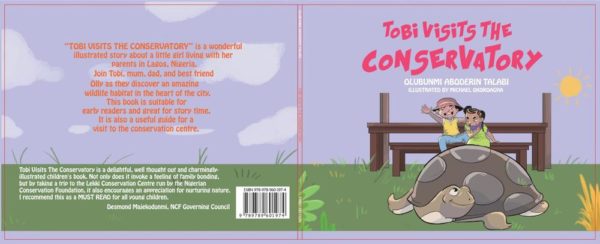
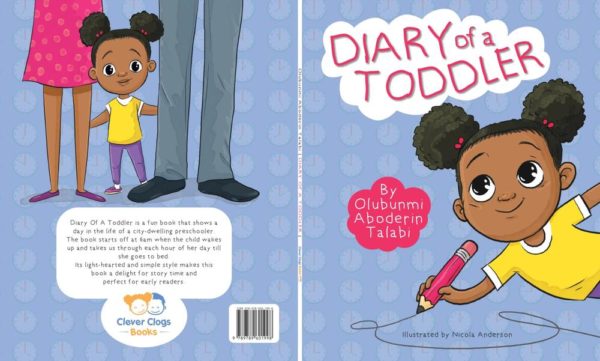
depict the content of the books. Authors like Olubunmi Aboderin Talabi
who recently launched a series of Nigerian themed children’s picture
books, show insights into the relevance of these books for children.
The writer and publisher through the
launch of her three unique books; The Tobi Series, Diary of a Toddler
and Kob the antelope, highlight family values and the need for children
to understand the environment in which they live; food and the necessary
health habits which children should cultivate.
The Tobi Series is aboutthe
urban adventures of a happy-go-lucky, three-year-old girl living with
her parents, a dual-career couple, in modern-day Lagos, Nigeria. Kob the Antelope is a story about stranger danger and teaches children obedience, and to be cautious of the environment they live in. Diary of Toddler
shows a day in the life of a city-dwelling preschooler. All books by
Olubunmi Aboderin Talabi are simplistic and deliberately light-hearted
and perfect for children. The books are also well illustrated in ways
that will spark and strengthen visual thinking, and introduce children
to the love of art.
The books convey succinct
contemporary Nigerian themes that help create a mental picture of the
immediate environment in the minds of the young readers, helping them
discover themselves first as Nigerians, and familiarizing them with our
culture, ideals and even delicacies. With these inspiring picture books,
children are introduced to the concept of reading, even if they cannot
read yet.
The author understands the importance
of changing the perception in the minds of the younger generation, that
reading is uninteresting because they have little or no access to
exciting, inspiring and well-illustrated picture books, as opposed to
textbooks.
In exploring ideas about what
Nigerian literature is, it is important to look at some of the things
that makes it important. Nigerian literature mirrors our society; it
makes us think about ourselves and our immediate environment; allows us
to enjoy our language and its beauty, and it reflects and changes
ideology. It would make a lot of difference to have children in Nigeria
experience all of these through literature, and help them understand
that reading can be enjoyable.


 “I think African people, Latin American people, Asian people, must
find a way of relating to each other a bit more and being able to say
one thing: let us make things with our resources. And then exchange with
others on the basis of equal give and equal take.”
“I think African people, Latin American people, Asian people, must
find a way of relating to each other a bit more and being able to say
one thing: let us make things with our resources. And then exchange with
others on the basis of equal give and equal take.”


 Growing
up in Nigeria is definitely interesting. Nigerians are natural
storytellers, who pass tales, myths and fables across generations;
shaping mentality, building morals and forming the unconscious blocks
that help children decipher the difference between right or wrong. The
stories, however, are not self-generated content, they are developed
from content written in storybooks and novels; while some were developed
by the exaggerations of elders while telling tales by moonlight.
Growing
up in Nigeria is definitely interesting. Nigerians are natural
storytellers, who pass tales, myths and fables across generations;
shaping mentality, building morals and forming the unconscious blocks
that help children decipher the difference between right or wrong. The
stories, however, are not self-generated content, they are developed
from content written in storybooks and novels; while some were developed
by the exaggerations of elders while telling tales by moonlight.